
Parent-Child Interaction Therapy’s Influence on Parental Behavior and Child Compliance in a Child-Welfare Involved Randomized Clinical Trial
Published in Child & Family Behavior Therapy, 2025
Abstract
Research on Parent-Child Interaction Therapy (PCIT) delivered to families with a history of maltreatment has demonstrated effects on increasing positive parenting and reducing negative behaviors, but no clear impact on child compliance. This study explores how specific parenting behaviors influence child compliance in families with a history of maltreatment. Data from a randomized clinical trial involving 204 parent-child dyads were analyzed. During a five-minute clean-up task, researchers observed distinct categories of parenting behaviors before and after PCIT. The results indicated that increased positive parenting behaviors and a decrease in the frequency of commands were associated with higher child compliance.
Learning Points
This manuscript presents a novel analysis of dyadic interactions between parents and children in a child-welfare-involved cohort. The data are from a randomized controlled trial that examined the efficacy of Parent-Child Interaction Therapy (PCIT).
Using a time-series analysis framed within a logistic regression, we examined how the sequence of parental actions influenced whether a child would comply with a parental command. The figure below shows an example of a time series from a single dyad, illustrating the data used in our model.
Here is an example of one of the timeseries from a single 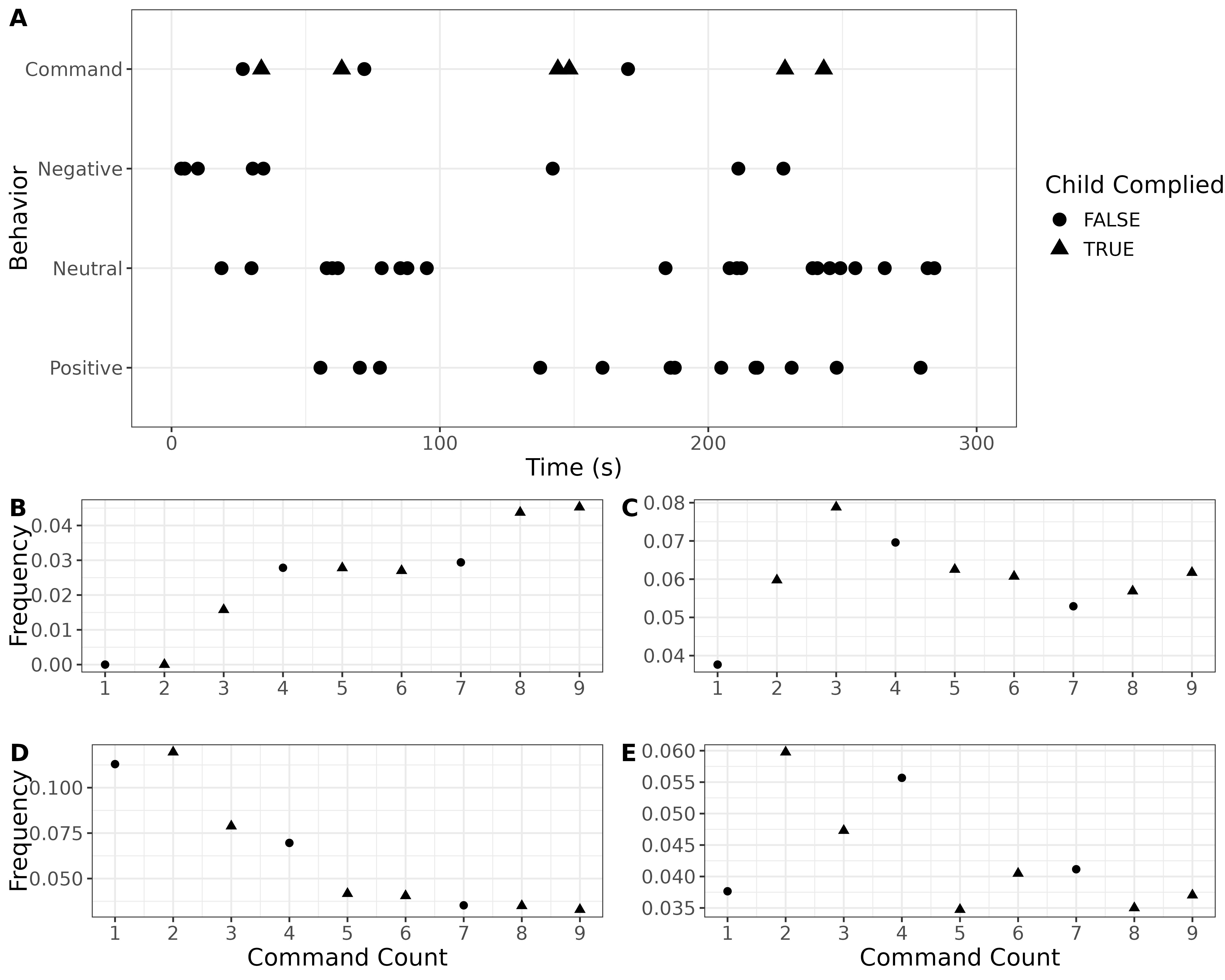
Recommended citation: Rosen, A. F. G., Kwasneski, K., Liao, X., Bard, D. E., & Skowron, E. A. (2025). Parent-Child Interaction Therapy’s Influence on Parental Behavior and Child Compliance in a Child-Welfare Involved Randomized Clinical Trial. Child & Family Behavior Therapy.